Sunday, April 10, 2011

At the vihara


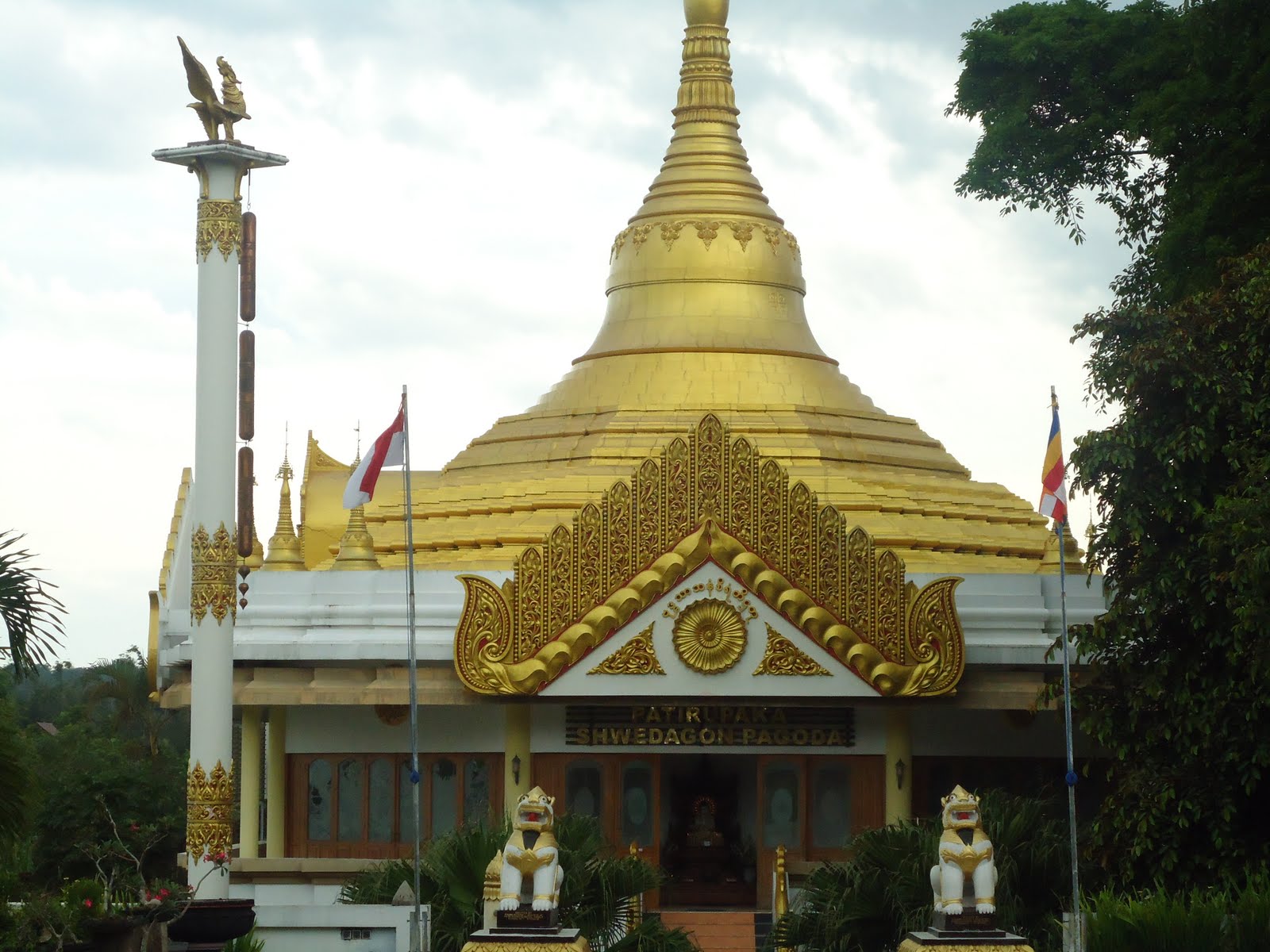
  Today I was invited (at the last minute of course) to go to the vihara, Buddhist monastery, just up the road, and give food offerings to the bhikkus (senior monks) and samaneras (maybe something like seminarians).  The vihara has become my second home as I have gone together with friends to have long chats with Sister Mutia, a "holder of the eight precepts."  She has been there since 1995, after studying to be a Protestant theologian and deacon for six years in Holland and after that, three years as a Hindu in Bali.  What a journey!  I only had time today to gather up some cookies from my pantry, although Mutia had offered to buy some from their own store, but I didn't find her.  So I humbly, really humbly, offered my cookies to the monks who passed by with their begging bowls by the table of foodstuffs arrayed in front of a line of lay people.  I had seen this practice of monks going out begging, and lay people acquiring "merit" by offering from their own food.  But here I was participating in it.  An even bigger privilege awaited me.  While all the hundred monks or so were eating,  I sat with some of the laity in the back of the dining hall, where I was suddenly told by a very young novice nun that I would be offering my food to the Abbot!  I was feeling so chagrined, and saying, "I don't have any food left; I gave it all away," when suddenly a tray of goodies, fermented coconut and "sticky rice" appeared, and I was able to bring it up to the front of the hall, in front of the hundred or so monks and about fifty lay people, laying it at the table of the head monk, Bhanti Kanti.  There were tears in my eyes as I offered it to him, and said, "I feel so privileged" to be able to do this.  Indeed, I felt more privileged than I had ever felt as a Fulbright scholar here.  The privilege was that of a simple human being being acknowledged just for that.

Thursday, April 7, 2011

Ayutheia, Old Capital of Thailand


Summer Palace of the Kings of Thailand

I could not leave the subject of Thailand without passing over the trip some of us took to the old town of Ayutheia, Thailand's capital for over 400 years.  After about an hour's bus ride north into the countryside, we arrived at the place where the kings had a summer palace, consisting of buildings spread over acres of land. There is the Golden Palace of the King, a corn cob structure in the style of the Khmer (Cambodians), the Assembly Hall for Royal Relatives (where we borrowed sarongs to be allowed inside, in case a royal relative came along), The Divine Seat of Personal Freedom (what a name!), and other structures such as the Excellent and Shining Heavenly Abode.  The whole compound apparently began with a monastery and was founded by a king who was an illegitimate son by a king who was shipwrecked on an island and befriended by a woman with whom he had this boy, who became the future king.  Such is the stuff of legends, but maybe true!  The palace grounds stood neglected for a century or more, until the mid-19th century when one of the kings began to restore them. Returning from Ayutheia, we had a most delightful river cruise. After touring the summer palace, we were taken to several "Wats," old Buddhist temples, most in ruins, where we discovered this head of the Buddha woven into the tree roots.   

 On a similar note, I could not believe the adoration and attention given to the current king of Thailand.  His picture, and that of his family, adorned medallions set above the roads and parkways.  Even scenes from his childhood!  It is adoration approaching idolatry, in this thoroughly Buddhist country.  Our host, Pontip, the Executive Director of Fulbright Thailand, told us that she "loves the king" and doesn't really sympathize with those "Red Shirts" who protest some of the policies of the monarchy (symbolized by yellow shirts).  She makes sure to wear yellow, along with many of her compatriots, at least once a week.  She avoids wearing red unless she is out of the country.  So much for color-coded politics!

Saturday, April 2, 2011

Fulbright Enrichment Conference, Thailand


In March, I was fortunate enough to be able to attend a Mid-Year Enrichment Conference sponsored by the Fulbright Thailand association, bringing together U.S. scholars and students in the Fulbright programs from their respective countries all around Southeast Asia.  About 60 or more of us gathered at the luxury Dusit Thani Hotel in Bangkok, and from the first "cocktail reception" I knew it would be a party.  Wine (!) flowed freely, and I found myself having to refuse a fourth refill on that first night, having gone wineless for the six or seven months here in Muslim Malang.  Thailand is Buddhist, but that doesn't stop ordinary lay people from the finer things, and we were treated to one after another gourmet meals and buffets.  Among the treats were trays of lobster tails, I remember at one point.  The feast carried over into the various paper presentations being given, under the overall banner of "America's Engagement in Southeast Asia:  the Role of People-to-People Ties in Strengthening Connections."  Panels were organized around topics of business, public health, religion and anthropology, biology, law, politics, and human rights, art and culture, art and education, and more!  The whole conference was topped off with a beautiful, moon-lit evening at the National Museum, us mostly garbed in the dress of our host countries, and adding to the splendor of the lovely Thai dancers who performed for us. 

     After that evening, we had the choice of "study visits" and I chose to attend the Thai Traditional Medicine one, offered at the traditional medicine clinic at a hospital in Bangkok.  There I experienced a diagnosis of my body-character (I am water and fire), making a healing compress, taking a steam detox, and of course massage.  Perhaps the best part of this truly "enriching" conference was the time spent getting to know other Fulbrights.  I talked to those from Laos, Cambodia, Malaysia, northern Thailand, Vietnam, and several other places that I can't even remember now.  It was a whirlwind, but really accomplished its purpose of giving us "people-to-people ties."  I am grateful for the experience.  

Sunday, March 27, 2011

Life in a Hindu Village

Musicians at clothing shop in Menyali Village
I did not want to let the story of my time in Bali pass without saying a little about the daily life of a Hindu village of Bali.  I presume that what I experienced with Pak Budasi, a very modern man with a Ph.D. from the premier Gadja Mada University in Yogyakarta, is still fairly close to what is typical.  To put it simply, the life of the Hindu village revolves around ceremony.  While for Muslims, prayer is often but not always in the mosque (you can get your prayer rug out anywhere and pray), for the Hindu it takes the form of offerings gathered and bought from flowers and fruits and arranged in little bamboo leaf dishes.  These offerings are placed everywhere, and we saw them in front of almost every shop in Ubud.  They ask the spirits for blessings of whatever endeavor is at hand, whether selling or farming or just living.  When we stopped at a Hindu Shiva temple, the primary god for Balinese of the many within the Hindu pantheon, we visited a woman whose task was to arrange these tasteful offerings for sale in temple ceremonies. 
  Just after we arrived at the Budasi family compound, we were invited to witness the annual blessing of the land belonging to this family, and so we trekked up a rather long hill passing the trees and plants planted to renew the land, and then watched while Pak Budasi and his wife made their dinner plate-size offerings.
  At the end of our stay, we were busy packing but got a glimpse of the blessing of a new motorcycle, with the priest saying prayers over the new bike amid several offerings.  Our visit to the family "sangha," the place where a number of shrines sit around the outskirts of a field and where once offerings have been made it is hoped that the ancestors of the family, those who have died and been cremated, will have their spirits descend and take up residence to bless and guard the family even more.  All of this sounded beautiful and "connected" to me, the living with the dead, the everyday with the world of spirit, the ordinary with the extraordinary.  To enter even more fully into the life of a Hindu village, visit the blog of my fellow Fulbrighter's wife, Judith Fox, who has lived for several months in a village to the south of Ubud, Batubulan:   http://macambali.wordpress.com/.

Wednesday, March 23, 2011

Nyepi, Day of Silence in Bali

A couple weeks ago, I learned that classes in the Pascasarjana (Post-Graduate School) of Universitas Muhammadiayah, where I am teaching this semester, would not be started.  So I scooted off to Bali for a long weekend and this time went by "Travel," which meant a 13 hour trip east including a long ferry ride to the little island.  On the map it looks close, but these roads make that an illusion.  Once there, I met up with Elisabeth, Regional English Language teacher at Universitas Jember, and a foreign student there, Sabrina, who is from Paris.  The first night was spent in a lovely hotel in Ubud (famous from the "Eat, Pray, Love" phenomenon), and a text message the first morning invited us to visit a professor whose village abutted the north coast of Bali.  As we drove north the next day, we met one after another large handmade figures, one more gruesome than the next.  These were the "ogoh, ogoh," which, we learned from our various guides, represent the low spirits.  How low can you go, I sometimes wondered as I saw grotesquely violent and rapacious beings being constructed on platforms for the processions that would follow that night.  Pak Budasi, our professor friend who hosted us in the village of Menyali, explained that they were not to be killed by fed and appeased, so that they would go to their proper place.  What astute psychology I thought; like Jung, the Balinese have known that the demons can't be destroyed but only quieted and befriended in some way.  By the time we were in the village, preparations were being completed for the ceremony to begin that evening.  We visitors stood in amazement and delight as one after another of these creatures came by carried on bamboo platforms by groups of boys and young men.  The whole event was a combination of Halloween, July 4th, and a religious observance--certainly it was a communal ritual full of good spirit.  After dark, and some combat between a few of the bad spirits, they were carried in procession around the village until they ended up in the cemetery where they were burned. 


  The next day was a total contrast to all that noise (including firecrackers that last into the night).  Nyepi's Day of Silence in Bali means no cars, airplanes, television transmission, no lights, and no fires.  People do not leave their family compounds, and though we had planned a walk with the village head, we stayed put all day, and took the opportunity to visit the family "sangha," a field of 17 shrines to the ancestors that sits on a rise above the rest of the family dwellings.  Up there Pak Budasi guided us in "pranayama" meditation, a form of breath control.  The whole experience of being in the village with such a tight-knit community feeling was comforting.  And the significance of Nyepi, which a brochure from Ubud describes as "a way to begin life anew, with the troubling and dark aspects of the past year put well behind us," was especially timely for me.
Saturday, February 26, 2011

Graduation at UMM with US Ambassador and Obama Contest

I know how neglectful I have been of the blog, but it is not for want of interesting events to report.  I will need to catch up!  The blogs from now on will be coming from me, Maria, since Bob has gone back to America.  But I had the pleasure yesterday of being at one of the three graduations this university holds each year, as it welcomed the US Ambassador to Indonesia, Scott Marciel to give the commencement address.  
Ambassador Scott Marciel and students

Everyone here, the Indonesians that is, say that he is much better than the last one, who was a "military sort."  And indeed, he as well as the Consul-General, Kristin Bauer, who has become a friend, have very warm, open personalities, not at all intimidating.  His speech was mercifully short, emphasizing the importance of the connection between our two countries, and how important Indonesia, such a large country with so many human and natural resources, is to the world and to America.  I was proud of my country and its ambassadors.
  But the most interesting part came afterward, when "Scott" and his staff went over to the "American Corner" (one of only a few in the country spreading the word about American education, culture, etc.) and participated in judging a contest of caricatures of President Obama done by high school students around the region.  I had watched the day before as the students sat for two hours on the campus doing the drawings.  They were amazingly good.  Even the likenesses of Obama were excellent.  But of course I was most interested in what they would say about how they perceived our president and his role in the world.  They were at least to my viewing universally positive.  One showed Obama filling the sacks of the world's poor countries with bread, peace, and freedom--a tall order for any human being, no matter how idolized.  Another, my favorite (and apparently the Ambassador's though not the Indonesian judges') showed Obama looking on in front of a background of mosques, churches, and temples while a Buddhist (I asked the artist who it was) wrapped arms around a Muslim and a Christian.  I told the young woman that one was close to my heart.  Ambassador Marciel gave it a "distinction" award.  I thought they were all wonderful, and such a window into the hearts and minds of the young people of Indonesia.
  I promise that more blogs will follow, so don't give up on me!

Thursday, February 3, 2011

On Retreat in Bali

Just returned from an amazing week in the mountains of Bali, complete with a visit to the village of Batubulan where fellow Fulbrighter, Richard Fox, lives with his family amidst a Bali family.  As we drove from the airport up higher into the mountains, accompanied by Fr. Yoseph, whom we were going to know and love during this week, all images of resorts and beaches dropped away.  Instead, we saw much natural beauty, green rice paddies, small villages with family "sanghas," beautiful little shrines for offerings of fruit and flowers right in the family compounds, and of course the mountains. 

Over the course of the next week, we were taken on "tour" to the lake temple, the "botanical gardens," lovely forests which stretched for miles, lush green rice fields, and even to Ubud for art gallery shopping and sightseeing.  In between, we had time to join the Carmelite priests and brothers twice each day for morning and evening prayer and for Mass.  The retreat house itself, built entirely with donations and with great beauty and simplicity, was like a hotel.  We couldn't have felt more welcomed.  In fact, Fr. Yoseph was so sad that we might leave after three days that he invited us back after our visit to Batubulan to see Richard (more about that in the next blog).  So we returned and had a chance to join a group of retreatants from Denpasar who were attending talks by a well-known priest-scholar from Malang who has invited me to his school of philosophy and theology.  Making these connections with the Catholic community has been very helpful to me as I hope somehow to link the Catholics of Malang with the Muslims I will be teaching and working with.  All that will be challenging, I suspect, but I am more hopeful now that I know these ties have been created before.  Just sitting face to face can undo so much distrust and suspicion, all too common I am learning in parts of Indonesia.  I have a feeling I will be back to this healing space before I leave Indonesia.